
Search
Reflections from Our Founder

Reflections: The Epic Transformations Leading to a Hope-Filled Renewal

The evening after Nova’s Annual Conference came to a close earlier this month, I sat outside under the deep blue vault of the night sky in a state of wonder at all that I had heard from the many inspirational speakers. Just above the horizon, I could make out the stars of Orion, and further to the north the Big Dipper, as my eyes searched for the line to Polaris, the North Star. I felt such a sense of reassurance, hope, and love. A tumultuous year is drawing to a close, but across the globe there are amazing people and communities following their own North Star — seeking renewal, transformation, and new ways of thinking, being, and taking action.

This extraordinary meeting attracts heart-centered “doers.” Their efforts touch physical, mental, emotional, social, economic, and environmental well-being, and they are resolutely focused on working toward enduring solutions, even when daunting obstacles seem to block the path. 
In these moments, I often think back to my studies of traditional Chinese medicine, which is rooted in the concept of the flow and movement of energy across internal and external factors. Disruptions to that flow causes dissonance and imbalance, often in the form of tension, pain, or disease. But life is made up of cycles and seasons and, by embracing and directing that flow, we can promote renewal and transformation. 

As a physician, I learned to apply these ideas across my practice. I took a broader view of pain, recognizing that a headache or persistent low back pain might be a sign of something deeper. In these cases, healing required far more than a prescription; it required a fuller exploration of a person’s life circumstances. I knew not to interrupt as someone sitting on the exam table described their symptoms, and I learned to listen as they were tying their shoes or preparing to leave the room.  The most compelling information often came when they had their hand on the doorknob, and turned back with an offhand, “This may be nothing, doc, but…”  At this point, the aspects of their life of most importance to them emerged, and a journey of deep understanding and healing began.

The people who gathered for our conference came from all sectors of our society, not just from medicine, like me. Whether they are economists, academics, educators, farmers, or artists, they are all listening. They are all asking what inner and outer forces are at work. They are all committed to shifting our consciousness and realigning our values. And, ultimately, they are all recognizing that the flourishing of people, places, and planet is not individual or time-limited work. Even in the depths of winter, we can prepare the soil and plant the seeds of change for a new world to emerge in the spring. 

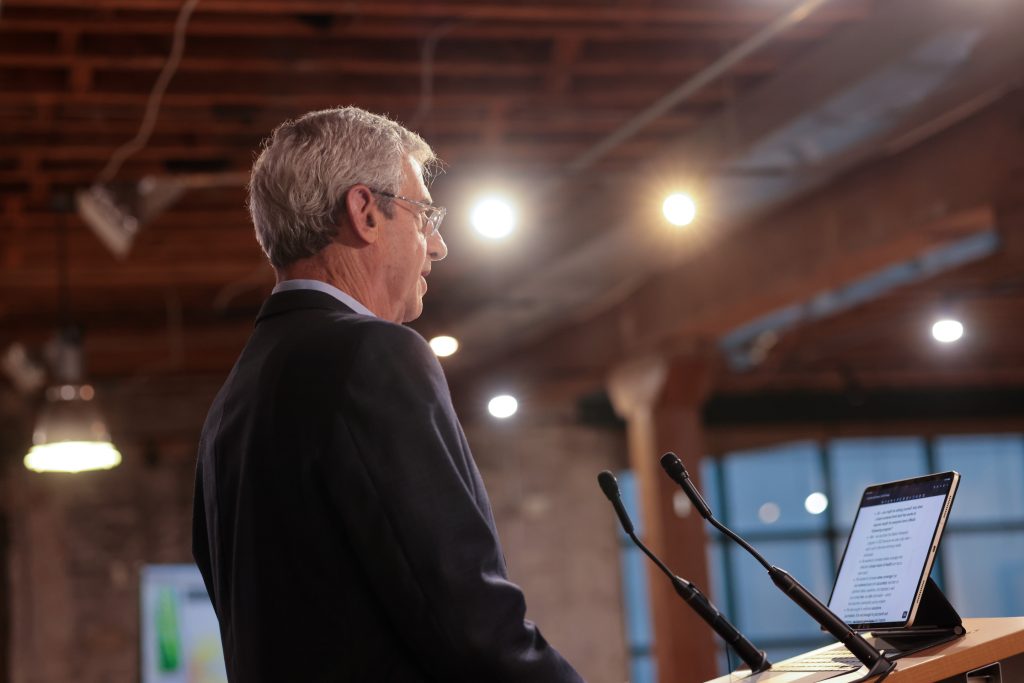
Gary Zukav, the bestselling author and a keynote speaker at our conference, describes an epic transformation that, over several generations, will help humanity see our world with a clearer understanding of love, vitality, and purpose. As he explained: “It’s not a transformation that is happening to us or in us. We are the transformation. You are the transformation. What you do, what you say, what you call into being, with your actions and your choice of intention is significant.”

This was the right message for our conference and for our community — a hope-filled reminder of the renewal happening all around us, all the time. As we build momentum toward 2025, thank you for the transformation you are calling into being.

Professor Brian Berman, MD
President and Founder, Nova Institute for Health
Professor Emeritus, Family and Community Medicine, University of Maryland School of Medicine

Healing is facilitated through safety, persistence, and trust.

  • Persistence: “People did not simply progress through this sequence and experience healing. The healing journey was a recursive, back and forth process. They found helpers, used the skills/resources that those helpers provided, found other helpers that provided more resources and used those skills and resources. As this process continued, people experienced a gradual amelioration of their suffering. Although many despaired at times, all demonstrated the quality of persistence—they refused to give up.”
  • Safety & Trust: “To connect to helpers, it was essential for people to feel safe in those relationships and able to trust that the person would be a helper and not a barrier to healing. Persons whose wounds included a violation of trust were especially careful about testing the safety of new relationships.”

Resources support us as we heal. They include reframing, responsibility, and positivity. “Making connections enabled participants to acquire and refine resources and skills that were essential in their healing journey. People also brought their own personal strengths to the journey.”

  • Reframing: “A particularly important skill was the ability to reframe—that is to look at suffering through a different lens.” This does NOT mean minimizing trauma or pain, but rather it often means the opposite: understanding what happened was wrong, unfair, or uncontrollable and that we are not to blame for it.
  • Responsibility: While we don’t have control over what happened to us, we are the only ones who can help ourselves heal. “A third essential resource that people acquired or refined was the ability to take an appropriate amount of responsibility for their healing journeys. They participated actively in the process of healing. Once again, some participants already had developed this skill, and some acquired or refined it from their helpers.”
  • Positivity: “Another resource that people acquired or refined during their healing journey was choose to be positive—that is to have some optimism about their situation.” People have varying predispositions to positivity. In the study, positivity was important in helping people heal. This doesn’t mean a toxic positivity, but rather simply finding some good in life and feeling hopeful about our situations.

“Connection to others was an essential part of all the healing journeys.” Humans are social creatures, and even the most introverted of us need close relationships. Friends and family add meaning and value to life and help support us, in good times and bad. 

When we experience relational trauma, relationships can feel scary, but reestablishing safety and trust in relationships is where the healing happens. (To be clear, we do not mean reestablishing safety and trust with abusers, but rather finding other healing relationships.) 

“When safety and trust had been established, people were able to connect with helpers. The nature of the behaviours of helpers that fostered healing ranged from small acts of kindness to unconditional love.”

  • “Moving from being wounded, through suffering to healing, is possible. It is facilitated by developing safe, trusting relationships and by positive reframing that moves through the weight of responsibility to the ability to respond.”
  • “Relationships with health professionals were among these but were not necessarily any more important to the healing journey than other kinds of helpers, which included family members, friends, spirituality and their God, pets, support groups, administrators, case workers and supervisors.”

Healing probably means different things to different people, but one definition that emerged from the study is: “The re-establishment of a sense of integrity and wholeness.” 

Healing was an emergent property that resulted from each individuals’ complex healing journey, a result of bridged connections between resources and relationships. “…they gradually found relief from suffering and began to exhibit emergent characteristics: a sense of hope, self-acceptance, and a desire to help others—the immediate precursors to healing.”

 In varying degrees, “they were able to transcend their suffering and in some sense to flourish.” 

  • Helping Others: We find meaning in helping others. “Understanding that suffering gives the strength and experience to help others in similar situations.”
  • Hope: We begin to have hope that we will not always feel this bad. A Crohn’s patient said, “I think gradually I realized that I was going to feel better. I did have days when I actually didn’t vomit, when I did feel better. And I think gradually I came to believe that maybe I could have a normal life again.”
  • Self-Acceptance: We see our inherent value and understand that we are not to blame for our suffering. A participant living with HIV said, “I’m really proud of myself. I think that now I still want to live. I don’t want to die, and I really love myself a lot. I have a lot of comfort in myself.”

Suffering is the ongoing pain from wounding. 

There is some debate about whether people always experience suffering on the path to healing.

Wounding happens when we experience physical or emotional harm. It can stem from chronic illness or by physical or psychological trauma for which we do not have the tools to cope, or a combination of those factors. 

“The degree and quality of suffering experienced by each individual is framed by contextual factors that include personal characteristics, timing of their initial or ongoing wounding in the developmental life cycle and prior and current relationships.”

Characteristics: How predisposed someone may be to wounding/how many tools and resources someone may have to deal with trauma/illness.

Lifestages: Developmental timing plays an important role in the impact of trauma — young children often do not have the same resources as older adults.

Relationships: Relationships can provide solace and support for those suffering, while lack of healthy relationships can prolong suffering.