

By Arianna Maysonave
September 10, 2025
"Collectively, connecting to nature is such a critical avenue for healing. Earth shows us how to live in harmony, how to create mutualisms—there’s so much wisdom there if we learn how to listen and observe the teachings that naturally emerge from the land, plants, fungi, and animals."
Nadine Clopton, Rodale Institute
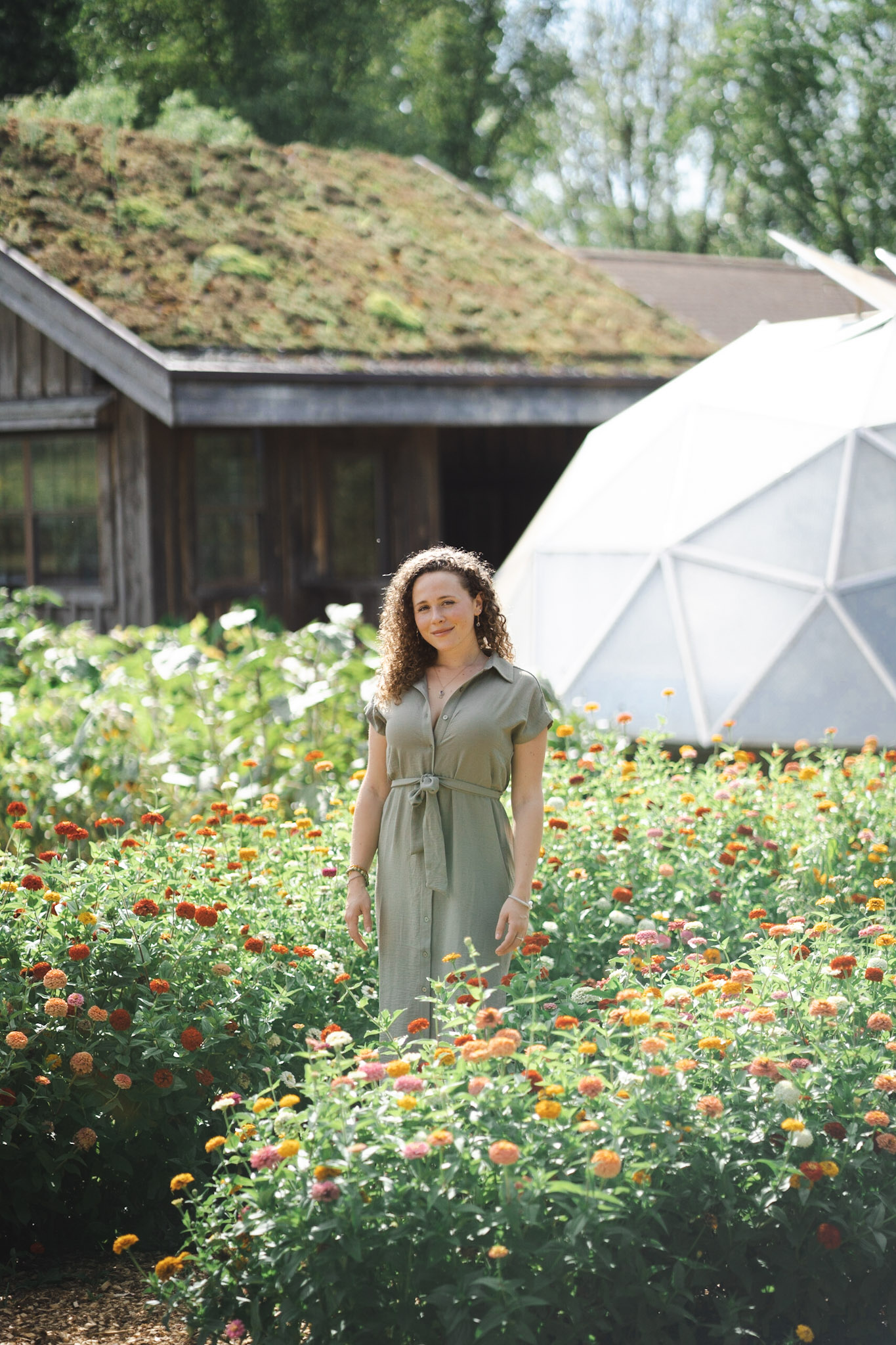
Nadine Clopton is devoted to cocreating a world rooted in compassion, community, and ecological wellness. She is a current member of the Invited Faculty for the Center for Planetary Consciousness and Global Flourishing at the Nova Institute for Health. At the time of this interview, she was She the regenerative education program manager at Rodale Institute, where she led consumer education initiatives at the intersection of regenerative organic agriculture and food as medicine.
She is also the cofounder of VendWell Provisions Co., making nourishing, eco-conscious snacking the new normal through accessible, curated kiosks that put community health first.
Rooted in her passion for systems change and advocacy, Nadine previously served as president of the Global NGO Executive Committee and as an NGO representative to the United Nations for Caring & Living As Neighbours.
Nadine holds a master’s in environmental policy design from Lehigh University, where she also earned a dual BA in political science and health, medicine, and society. She lives in Pennsylvania on the ancestral homelands of the Lenni Lenape people, and finds joy in singing, herbalism, writing, connecting with nature, and seeking wonder in the everyday.
Rodale Institute is a 501(c)(3) nonprofit dedicated to growing the regenerative organic agriculture movement through rigorous research, farmer training, and education. Their groundbreaking science and direct farmer support programs serve as a catalyst for change in farming and food production worldwide. Over their 75-year history, Rodale has proven that organic farming is not only viable, but essential to humanity’s survival.
Tell me about the work that you do in the world.
Nadine Clopton (NC): I identify as a systems midwife. That’s the term that resonates most deeply for me—the times we’re in require a lot of holding, a lot of tending. We’re in a kind of collective birthing process, moving through these messy, transitional times and needing people who can help steward something new into being.
At Rodale and beyond, I’ve been thinking about what this emergent paradigm needs to look like. What values and systems should be at the center? What’s currently not functioning? My niche is in agriculture and food systems—areas that have long reflected a deep separation of consciousness: separation from nature, from each other, and from community. My role, both professionally and personally, is to help reweave those connections through ecology, community, and local foodsheds—the geographical area between where food is produced and where the food is consumed. I’m interested in how our health is tied to agriculture, how it’s connected to the health of the nearest river, and how we can live in ways that sustain us on a daily basis.
What is your background and how did you become a systems midwife?
NC: Academically, my background is in political science, public health, and sustainable development, with a master’s in environmental policy design. I’ve always leaned into the interconnections between systems that are typically seen as separate. That curiosity deepened during the pandemic when I had just finished grad school. Amid a hiring freeze, I moved to Vermont for about a year and, for the first time, lived really close to the land. I grew up on a quarter of an acre in the suburbs of Philadelphia, so Vermont’s wildness felt like a whole new world.
There, I made friends, many in their 60s and 70s who were deeply rooted in earth-based wisdom. I completed an herbalism apprenticeship, learning how to grow, process, and connect with plants. This was incredibly transformative. I also worked with a dear one trained in shamanic arts who guided me through a six-month deep dive with the Purpose Guides Institute. It was the first time I had a structure for exploring my soul’s purpose—how I can be of service to humanity and to Mother Earth, and what parts of myself I needed to shed in order for something else to emerge.
This introspective time supported me in alchemizing a lot of past experiences and integrating them into the greater context of my life. That journey culminated in an immersive, 24-hour soul quest—inspired by vision quests and rites of passage from Indigenous communities throughout Turtle Island—while fully fasting in the forest. I brought nothing but a small drum, journal, and pen.
In a wild turn of events, days after that experience, I ended up fighting a forest fire on that same land. It was a profoundly moving experience, hiking up the mountain at night with a few close loved ones while carrying water on my shoulders to extinguish the fire, singing and praying as I went along. Through that experience, I gained a lot of clarity around who I am at my core and how I can best show up in service to the world at this time. Our systems (food systems, health care, governance, education, etc.) are at a critical inflection point right now and are in dire need of transition away from extractive, exploitative systems to ones rooted in care. I’d like to offer my hands to that rebirthing process as we bring forth emergent systems and ways of relating into being. Systems midwife is the best descriptor I can think of at this point.
How do you conceptualize the separation of people from the land? What is the impact on our personal and collective well-being?
NC: When we are born, the umbilical cord is cut, and we’re severed from our birth mother. However, in the Western world, we’re not given the socio-cultural framework for rooting into our Earth Mother in the way that many Indigenous teachings have. We’ve lost our sense of being in relation to Earth and each other, so we walk around in a default state of disconnection, feeling like something’s missing. I really see people crying out internally for a deeper sense of meaning, but capitalism gives us no tools to find reconnection. Our metrics for success, like gross domestic product, do not account for ecological, physical, or spiritual well-being. I believe rites of passage are critical throughout childhood and especially when coming into young adulthood. When we support young people in finding themselves at a soul level and in finding a deeper sense of purpose, they start to see their role in the healing and well-being of the whole. This can reframe our sense of place in the world—from one of extraction to one of generativity.
I like to say that we have to deconstruct to reconstruct. Many systems were built with good intentions, but they’re no longer serving us. It takes courage to imagine something new. I like to think of reform as a process of reimagination—instead of hyper-fixating on what’s broken, let’s ask: what do we want to build?
However, we can’t create from a place of dysregulation. It’s a process to come back to regulation, especially when we’re so overstimulated and constantly bombarded with technology. Reconnection and regulation are foundational.

Nadine Clopton explores the ties between soil health and community well-being.
Tell me about your perspective regarding the intersection of personal and planetary well-being through the lens of soil health and ecology.
NC: It’s all rooted in relationship—in how we connect to place—from the community we’re in to the soil beneath our feet. We’re so disconnected from our local food systems, our communities, and each other. Globalization has its benefits, but we’ve lost something essential along the way. We’re out of sync with what our bodies truly need, the rhythms of Earth’s seasons, and with that we’ve lost attunement to the abundance that Earth can offer.
There’s this idea of a local societal ecology, where we once relied on our neighbors, our ecosystems, and our local farmers. While we may never return fully to that model, getting even 30 percent closer would make a huge difference in creating connection, reducing emissions, and supporting the local economy.
Elaborate on the state of soil today—do you see a path to a more sustainable way of growing food?
NC: Think about the microbiome of the soil—there are billions of microbes working beneath our feet that are essential to our survival. And yet, we rarely think about them. Thirty soccer fields of soil are lost every minute due to intensive agriculture. We’ve taken healthy soil for granted, and it’s showing. Studies have found glyphosate in 80 percent of urine samples taken in the United States. There are PFAS and microplastics in cord blood—it’s even in the rain. These pervasive toxins aren’t going anywhere—they are here for as long as it takes the planet to detox them. We need to act now.
There’s a statistic floating around—the UN says we have sixty harvests left at this rate. Whether or not that number is exact, the sentiment holds: we’re rapidly depleting the very ground we rely on. But we can stop making it worse.
It’s interesting to imagine how we make this crisis fit into the structure of capitalism, as it’s clearly not going anywhere anytime soon. One huge opportunity is in regards to health care spending. Ninety percent of health care dollars go to managing chronic disease—and the United States Department of Agriculture’s entire budget is a fraction of that. What if we invested in healing through food, through soil, through systems? If we were able to align human health, soil health, and agriculture to work toward a common goal—planetary health—there is an incredible opportunity. Instead of just another Band-Aid on the chronic disease epidemic, this would look like investing in supplying folks with real, healthy food and cleaning up our farming practices on a massive level.
What role does the microbiome play in our mental and physical health, and how does soil relate to wellness?
NC: The microbiome is critical to both mental and physical health. In integrative and functional medicine, people have long known this. But in conventional medicine, it’s still often an afterthought.
Our microbiome is our biggest point of contact with the outside world. Every time we eat, our gut interacts with the food, and through that, the soil it was grown in. If that food is grown with synthetic inputs—such as herbicides, pesticides, fertilizers, and fungicides—those residues can disrupt our internal ecosystem.
Healthy soil grows healthy food. When soil is chronically depleted of essential minerals and nutrients, our food can be less nutritious—this is what we call “hidden hunger.” You now have to eat about eight oranges to get the same nutrition your great-grandparents got from one. That’s how depleted our systems are!
And conventional medicine and conventional agriculture are new systems, not traditional ones! Language is funny (and scary) in that way. In the 1930s and 1940s, post-WWII, the United States repurposed excess nitrogen from bombs to be used in agriculture—something about that just isn’t right. The pace of innovation since then has been astonishing. We went from no cell phones to supercomputers in our pockets in just a couple decades. But our biology hasn’t evolved to keep up.
In your work at the Rodale Institute, you strive to bridge health care and regenerative organic agriculture. What does that look like in action?
NC: I manage the Institute’s regenerative health program, which is our main avenue for connecting human health and soil health. We run educational initiatives for consumers and health care providers, including the Regenerative Healthcare Conference. Most doctors get fewer than 19 hours of nutrition education in medical school,so we look to fill these educational gaps through offering a space for them to learn about food, farming, and the connections between human and ecological health all in one place.
We’re also growing our farm to institution model through work with institutions—hospitals, universities, and health care systems more broadly—because they are powerful levers for change. Institutions by nature purchase a great deal of food and own significant amounts of land. How they steward that land and source their food has ripple effects. We’re actually cohosting a farm-to-institution symposium at the University of Virginia on October 9th, 2025 to dive into this topic!
One of my favorite examples of a farm-to-institution model is Rodale Institute’s partnership with St. Luke’s, a hospital network in Pennsylvania. Together, we co-manage a 14-acre organic farm. All the food grown there goes straight to patients, hospital cafeterias, and a community-supported agriculture program for employees. It’s a beautiful model—many hospitals have land they lease to commodity farmers, but this is a much more generative model that is mutually beneficial for people, the hospital, and land alike.
We’re not prescriptive. Institutions come to us at different points in their journey, and we can support them wherever they are. We even have a consulting arm to help with everything from sourcing local food to rethinking land management. There’s a spectrum of ways to engage.
How does fostering a connection to nature contribute to our personal and collective well-being?
NC: Collectively, connecting to nature is such a critical avenue for healing. Earth shows us how to live in harmony, how to create mutualisms—there’s so much wisdom there if we learn how to listen and observe the teachings that naturally emerge from the land, plants, fungi, and animals.
We are not meant to be separate from nature. That’s a very new phenomenon over the past hundred years or so. The more we are able to walk back to a state of harmony by attuning ourselves to nature, the more we return to a state of balance.
This also goes beyond the John Muir or Thoreau perspective of wild, grand nature. You don’t need to be in Yosemite to feel that connection. A dandelion growing through a crack in the sidewalk can be medicine and can inspire connection. In cities, how can we cultivate that relationship? A small park in an urban landscape can be a beautiful place to pause and reconnect. It’s about reframing our relationship with nature—from nuisance to teacher, from other to kin.
We also need to see ourselves as part of ecology. Western frameworks often paint humans as either destructive or separate. But we are keystone species. Indigenous communities have long known this—they actively managed land in ways that enhanced ecosystem health and in many cases their languages don’t even have a word for nature because there’s nothing separate from nature. (Again, I’m a total linguistics nerd.) Colonization severed that relationship, and today the interaction between man and nature is often overly extractive or filled with neglect. Part of the work today is to support Indigenous communities in reclaiming and preserving their deep wells of knowledge, looking to tradition as a roadmap to find our way back into right relationship and reciprocity. In retracing the threads and providing support, there is much to learn from our ancestors.
What’s bringing you joy in these complex times? Where do you find hope?
NC: Music—both making it and listening to it—is a constant source of joy and hope. My local farmers market, June strawberries, and watching our cat hang out in our raised bed garden is bringing me joy right now, which feels necessary in the midst of immense collective pain nationally and globally.
Locally, zooming out from the national narrative to focus on the good happening in my community brings me back to center.
Right now, we’re working on creating a food hub in the Lehigh Valley—a place where farmers can bring produce to be aggregated, processed, and sold to institutions and restaurants. It’s about strengthening our local food system and making it easier to source locally—putting the right systems in place to facilitate that. Seeing the good in my own backyard is inspiring. There are so many people in communities all over the place who are committed to making a difference and doing good in the world.
I also find hope in children—in keeping their instincts and curiosity alive despite the world we’ve created. Also fireflies. And butterflies—the whole process of metamorphosis never ceases to amaze me. And in pulling away from the doom and gloom and leaning into the bright spots. They’re everywhere if we look.

Nadine finds balance through her connection to nature.
This interview is part of the Nova Institute for Health’s Insight Collaborative for Mental Well-Being project. The Insight Collaborative is supported by a generous seed grant from the Mental Insight Foundation.


